
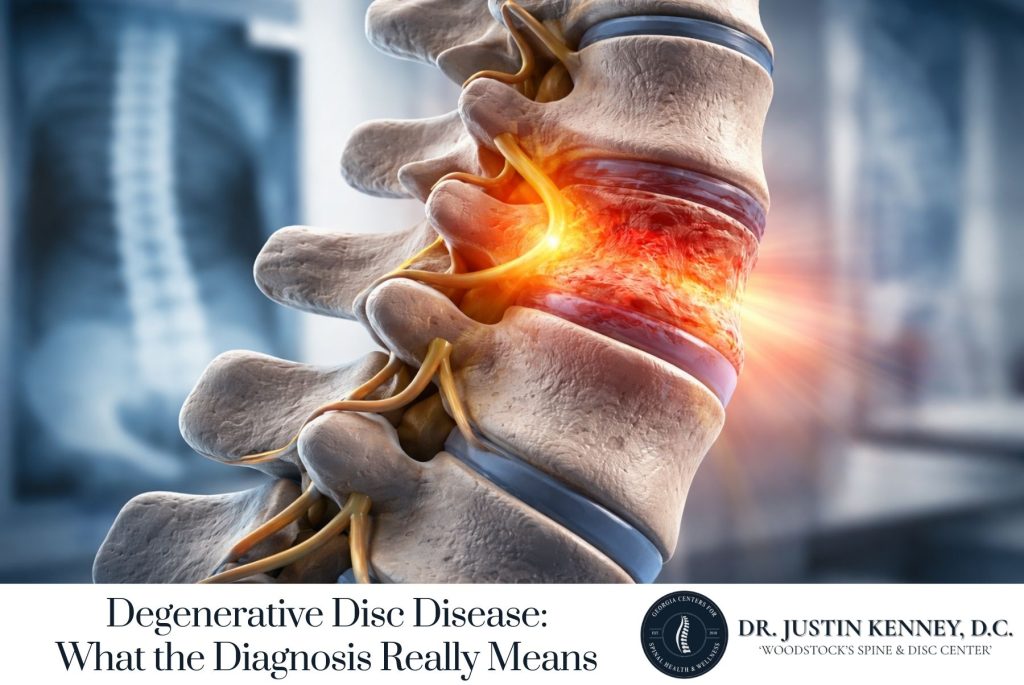
Hearing the words “Degenerative Disc Disease” can feel alarming. The term “disease” alone often causes concern, leading many patients to imagine a progressive or debilitating condition. However, the reality is much more nuanced—and often far less frightening.
At Georgia Centers for Spinal Health & Wellness, we believe patient education is the first step toward effective treatment and long-term spinal health. If you’ve recently been diagnosed with Degenerative Disc Disease (DDD), this guide will help you understand what it really means, what to expect, and what you can do about it.
What Is Degenerative Disc Disease?
Despite its name, Degenerative Disc Disease is not actually a disease. It is a condition that describes natural, age-related changes in your spinal discs.
Your spine is made up of vertebrae (bones) separated by intervertebral discs. These discs act as cushions or shock absorbers, helping you move comfortably and protecting your spine from everyday stress.
Over time, these discs can:
- Lose hydration
- Become thinner
- Develop small tears in the outer layer
- Lose some flexibility
These changes are normal and happen to nearly everyone as they age. However, not everyone experiences pain. Degenerative Disc Disease is diagnosed when these changes cause symptoms such as discomfort, stiffness, or nerve irritation.
Why Does It Cause Pain?
There are several reasons degenerating discs may lead to pain:
- Inflammation: Small tears in the disc can trigger inflammation.
- Instability: Thinning discs may alter spinal alignment.
- Nerve Compression: Disc changes can lead to bulging or herniation, irritating nearby nerves.
- Muscle Tension: The body may tighten surrounding muscles to protect the spine.
The most common areas affected are the lower back (lumbar spine) and neck (cervical spine).
Common Symptoms of Degenerative Disc Disease
Symptoms vary from person to person but often include:
- Chronic low back or neck pain
- Pain that worsens when sitting
- Pain that improves with walking or movement
- Stiffness in the morning
- Radiating pain into the arms or legs
- Numbness or tingling (if nerves are involved)
- Pain that comes and goes over months or years
Symptoms may flare up and then improve for periods of time.
What Causes Degenerative Disc Changes?
Several factors contribute to disc degeneration:
- Natural aging
- Repetitive strain or heavy lifting
- Poor posture
- Previous injury
- Genetics
- Smoking
- Obesity
Even individuals who maintain a healthy lifestyle can experience disc degeneration as part of the aging process.
How Is Degenerative Disc Disease Diagnosed?
Diagnosis typically involves:
- A detailed medical history
- Physical examination
- Imaging such as X-rays or MRI
Imaging helps identify disc height loss, bulging discs, or other structural changes. However, it’s important to note that many people have disc degeneration visible on MRI without any pain at all. Symptoms and clinical findings matter more than imaging alone.
Treatment Options: You Have Choices
The good news is that most cases of Degenerative Disc Disease can be managed without surgery.
At Georgia Centers for Spinal Health & Wellness, treatment focuses on reducing pain, restoring mobility, and strengthening the spine.
Common non-surgical treatments include:
Conservative Care
- Chiropractic adjustments
- Physical therapy exercises
- Spinal stabilization programs
- Postural correction
Pain Management Strategies
- Anti-inflammatory treatments
- Muscle relaxation therapies
- Targeted spinal therapies
Lifestyle Modifications
- Weight management
- Ergonomic improvements
- Core strengthening exercises
- Smoking cessation
When Is Surgery Needed?
Surgery is typically considered only when:
- Severe nerve compression is present
- Symptoms persist despite conservative care
- There is significant weakness or loss of function
Fortunately, most patients improve with non-invasive approaches.
Can Degenerative Disc Disease Be Reversed?
While the structural changes of disc degeneration cannot be completely reversed, symptoms can often be significantly reduced or even eliminated. Many patients return to full, active lifestyles with the right treatment plan.
The focus is on:
- Improving spinal mechanics
- Reducing inflammation
- Strengthening supportive muscles
- Preventing future flare-ups
Long-Term Outlook
Degenerative Disc Disease is manageable. Many patients find that symptoms stabilize over time. With proper care and ongoing maintenance, you can continue enjoying daily activities with minimal disruption.
The key is early intervention and a proactive approach.
Comprehensive Q&A Section
Q: Is Degenerative Disc Disease a serious condition?
A: It can be uncomfortable, but it is not typically dangerous. It is a common age-related condition. Serious complications are rare and usually involve nerve compression.
Q: Is it the same as a herniated disc?
A: Not exactly. Disc degeneration can lead to herniation, but they are separate conditions. Degeneration refers to wear and tear, while herniation involves disc material pushing outward.
Q: Will it get worse over time?
A: Disc degeneration may progress slowly, but symptoms do not always worsen. Many patients experience periods of improvement.
Q: Can exercise make it worse?
A: Appropriate exercise usually helps. Strengthening core muscles and improving flexibility can reduce strain on the spine. High-impact activities may need modification.
Q: Is sitting bad for Degenerative Disc Disease?
A: Prolonged sitting increases pressure on spinal discs. Taking breaks and improving posture can help reduce discomfort.
Q: Does everyone develop this condition?
A: Nearly everyone experiences some degree of disc degeneration as they age. However, not everyone develops pain.
Q: Can chiropractic care help?
A: Yes. Chiropractic adjustments and spinal therapies can help restore alignment, reduce inflammation, and improve mobility.
Q: Should I avoid lifting weights?
A: Not necessarily. Proper form and guided strengthening exercises can be beneficial. It’s important to work with a healthcare provider.
Q: Is this condition permanent?
A: The structural changes are permanent, but symptoms can often be controlled or eliminated with proper care.
Q: When should I seek medical attention?
A: If you experience worsening pain, weakness, numbness, or loss of bladder or bowel control, seek immediate medical evaluation.
Take the Next Step Toward Relief
If you’ve been diagnosed with Degenerative Disc Disease or are experiencing chronic neck or back pain, you don’t have to manage it alone.
At Georgia Centers for Spinal Health & Wellness, we provide personalized, evidence-based treatment plans designed to restore function and improve quality of life.
Contact Information
Georgia Centers for Spinal Health & Wellness
99 Weatherstone Dr. Suite 940
Woodstock, GA 30188
Phone: (678) 388-7670


