
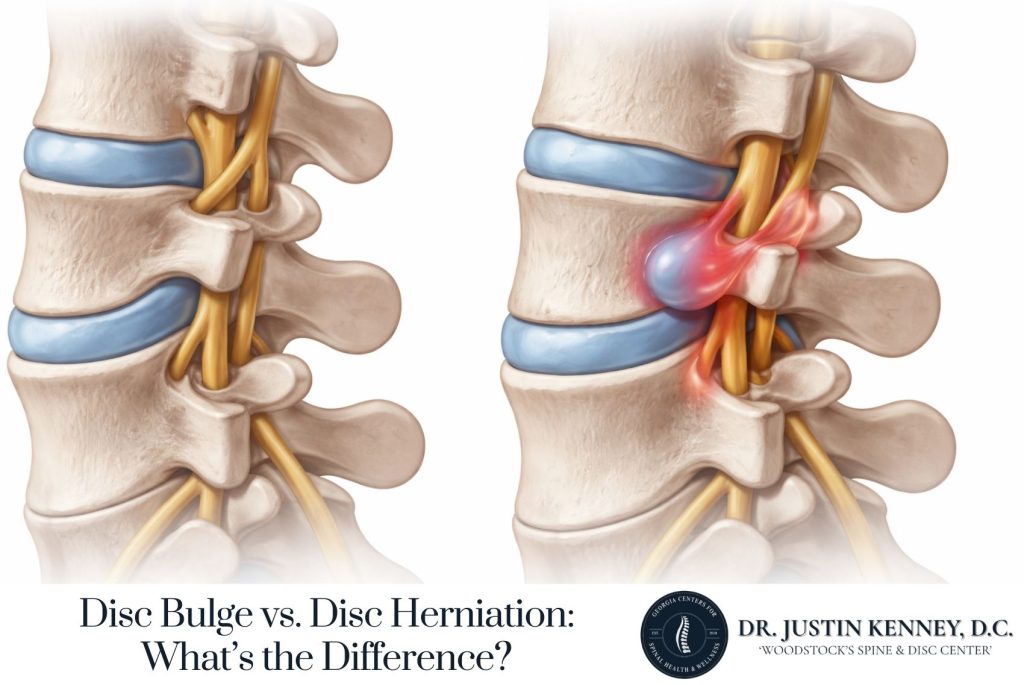
Back pain is one of the most common health complaints among adults, and two frequently misunderstood causes are disc bulges and disc herniations. While these conditions are often used interchangeably, they are not the same — and understanding the difference is essential for receiving the right treatment.
At Georgia Centers for Spinal Health & Wellness, we specialize in diagnosing and treating spinal disc conditions with advanced, patient-centered care. If you’re experiencing persistent back pain, neck pain, numbness, or radiating discomfort, understanding what’s happening in your spine is the first step toward relief.
Let’s break down the differences between a disc bulge and a disc herniation.
Understanding Spinal Discs
Your spine is made up of vertebrae stacked on top of one another. Between each vertebra is a soft, cushion-like structure called an intervertebral disc. These discs act as shock absorbers and allow flexibility in the spine.
Each disc has two main components:
- Annulus fibrosus – the tough outer layer
- Nucleus pulposus – the soft, gel-like inner core
When discs become damaged or weakened, they may bulge or herniate — leading to pain and other symptoms.
What Is a Disc Bulge?
A disc bulge occurs when the disc extends outward beyond its normal boundary, but the outer layer (annulus fibrosus) remains intact. Think of it like a hamburger that’s slightly too big for its bun — the contents push outward evenly.
Key Characteristics of a Disc Bulge:
- The disc protrudes uniformly.
- The outer layer is not torn.
- Often develops gradually due to aging and wear-and-tear.
- May not always cause symptoms.
Disc bulges are relatively common, especially as we age. In fact, many people have bulging discs without even knowing it. However, if the bulge presses on nearby nerves, it can cause pain, tingling, or numbness.
What Is a Disc Herniation?
A disc herniation (sometimes called a slipped or ruptured disc) is more severe. It occurs when there is a tear in the outer layer of the disc, allowing part of the inner gel-like material to push out.
Key Characteristics of a Disc Herniation:
- The annulus fibrosus is torn.
- The nucleus pulposus protrudes through the tear.
- More likely to irritate or compress nearby nerves.
- Often causes sharper, more intense pain.
Herniated discs are more likely to produce noticeable symptoms because the leaked disc material can directly inflame or compress spinal nerves.
Disc Bulge vs. Disc Herniation: The Main Differences
| Feature | Disc Bulge | Disc Herniation |
| Outer Layer | Intact | Torn |
| Shape | Broad, uniform protrusion | Localized protrusion |
| Severity | Typically milder | Often more severe |
| Nerve Compression | Possible | More likely |
| Pain Level | Mild to moderate | Moderate to severe |
Both conditions can occur in the neck (cervical spine), mid-back (thoracic spine), or lower back (lumbar spine). Lumbar disc issues are the most common.
Symptoms of Bulging and Herniated Discs
Symptoms vary depending on the location and severity, but may include:
- Lower back or neck pain
- Radiating pain into arms or legs (sciatica)
- Numbness or tingling
- Muscle weakness
- Pain that worsens with movement
In severe cases, herniated discs can affect bowel or bladder control, which requires immediate medical attention.
Causes and Risk Factors
Both disc bulges and herniations may result from:
- Aging and disc degeneration
- Poor posture
- Repetitive strain
- Heavy lifting
- Traumatic injury
- Obesity
- Sedentary lifestyle
As discs lose hydration and elasticity over time, they become more prone to damage.
How Are These Conditions Diagnosed?
At Georgia Centers for Spinal Health & Wellness, diagnosis begins with a thorough physical examination and review of your symptoms. Advanced imaging such as MRI may be used to confirm the condition and determine its severity.
Accurate diagnosis is critical because treatment plans differ depending on the extent of nerve involvement and disc damage.
Treatment Options
The good news is that most disc bulges and herniations can be treated without surgery.
Conservative Treatment May Include:
- Spinal decompression therapy
- Chiropractic care
- Physical therapy
- Anti-inflammatory strategies
- Corrective exercises
- Postural rehabilitation
For more severe cases, interventional procedures may be recommended.
Our team focuses on personalized treatment plans that address the root cause — not just the symptoms.
Comprehensive Q&A Section
Q: Is a disc bulge the same as a herniated disc?
A: No. A disc bulge involves the disc pushing outward while remaining intact. A herniated disc involves a tear in the outer layer, allowing inner material to escape.
Q: Which condition is more painful?
A: Herniated discs are typically more painful because the inner disc material can irritate nearby nerves. However, pain levels vary by individual.
Q: Can a disc bulge turn into a herniation?
A: Yes. Over time, continued pressure or strain may cause a bulging disc to rupture, leading to herniation.
Q: Do all bulging or herniated discs require surgery?
A: No. The majority of cases respond well to conservative, non-surgical treatments.
Q: How long does it take to heal?
A: Recovery varies. Some patients improve within weeks, while others require several months of structured treatment.
Q: What is sciatica, and how is it related?
A: Sciatica refers to pain that radiates down the leg due to compression of the sciatic nerve, often caused by a herniated or bulging disc in the lower back.
Q: Can exercise help?
A: Yes — when guided by professionals. Specific strengthening and stretching exercises can stabilize the spine and reduce symptoms.
Q: When should I seek medical attention?
A: If you experience persistent pain, numbness, weakness, or changes in bowel/bladder control, seek evaluation promptly.
When to See a Specialist
If your back or neck pain lasts more than a few days, worsens, or interferes with daily activities, it’s time to consult a spinal specialist. Early treatment often leads to faster recovery and prevents further complications.
At Georgia Centers for Spinal Health & Wellness, we are committed to helping patients regain mobility, reduce pain, and restore quality of life through comprehensive spinal care.
Contact Georgia Centers for Spinal Health & Wellness
Georgia Centers for Spinal Health & Wellness
99 Weatherstone Dr. Suite 940
Woodstock, GA 30188
Phone: (678) 388-7670


